

If you are looking to start an organic farming business, setting up a vermicompost unit is one of the smartest decisions you can make. The demand for chemical-free, natural fertilizer is growing every single day.
But when people look for a “vermi compost unit near me” to learn how it works, they often get confused by the high costs and complicated designs found on the internet. At Jaivik Roots, operating from our main farm in Raisen, we believe in keeping things simple, practical, and highly profitable.
In this guide, we will share our real, on-ground experience to help you understand the exact cost, the best designs, and the step-by-step process for setting up your own vermicompost production unit.
3 Types of Vermicompost Unit Design (Which is Best?)

When planning your vermicompost unit design, you generally have three main options. You should choose the one that fits your budget and land size.
1. HDPE Vermi Beds (Good for Quick Setup) HDPE stands for High-Density Polyethylene. These are ready-made, flexible beds usually made of 350 to 450 GSM UV-stabilized fabric. They are lightweight, easy to install, and provide good airflow. A good quality HDPE bed can easily last you 5 to 7 years.
2. Concrete Tank Systems (Permanent & Long Lasting) If you own the land and want a permanent setup, concrete pits are a great choice. These are built using cement and bricks. A standard commercial size for these tanks is usually 10 feet long, 4 feet wide, and 2.5 feet deep. These tanks are excellent at keeping the temperature cool and controlling moisture, which is very important for the earthworms.
3. The Low Cost Vermicompost Unit (The 30-Foot Plastic Bed) If you want to start a large-scale commercial unit without spending too much money on cement or expensive bags, this is the most popular method. You simply create an open 30-foot bed on the ground using 19-1 black plastic sheets. To hold the shape and keep the compost safe, you just place bricks along the edges. This low-cost vermicompost unit is what maximum commercial setups use to scale their business fast and cheaply.
The Real Truth About Cow Dung (Gobar) Quantity
Here is a very important secret that you will not find in standard textbooks.
If you search on YouTube or read articles on the internet about the 30-foot open bed model, almost everyone claims that you only need 1500 KG of gobar (cow dung) to fill the bed.
However, as per our real experience at Jaivik Roots, this internet data is misleading. When you procure fresh gobar, it contains a lot of water weight. Once you process it and it settles down, you will actually need around 2100 to 2300 KG of fresh gobar to properly fill a standard 30-foot bed. Knowing this real number will help you plan your budget and transport costs much better!
Step-by-Step: Setting Up Your Vermicompost Unit
Building your vermicompost unit setup is easy if you follow these basic steps:
-
Step 1: Choose a Shaded Location. Earthworms do not like direct sunlight or heavy rain. Set up your beds under a tree, inside a shed, or under an agro-shade net to keep the heat away.
-
Step 2: Prepare the Bedding. Put down a layer of partially decomposed cow dung (gobar) mixed with some dry leaves or crop leftover.
-
Step 3: Add the Earthworms. For the best results, use the Eisenia fetida (Red Wiggler) species. You will need to add about 1 kg of live earthworms for every square meter of your bed surface.
-
Step 4: Maintain the Moisture. This is the most critical step. You must sprinkle water regularly to keep the moisture level between 60% and 80%. If it is too dry, the worms will die. If it is too wet, they won’t be able to breathe.
-
Step 5: Harvest the Black Gold. In about 45 to 60 days, the worms will eat the gobar and turn it into dark, tea-like powder. This is your premium vermicompost, ready to be packed and sold.

Cost of Vermicompost Unit & Government Subsidies
A major question people ask is about the financial investment. When building a commercial-scale facility, the capital cost generally comes out to about ₹5,000 to ₹6,000 for every tonne of vermicompost production capacity you want to build. This covers your sheds, beds, and initial earthworm purchase.
Great News for Farmers: You don’t have to pay for it all by yourself! The government highly supports organic farming. For example, under current schemes in Madhya Pradesh, the government provides a massive 75% subsidy (up to ₹33,300 per unit) for setting up a vermicompost unit. This subsidy covers pit construction and buying the earthworms.
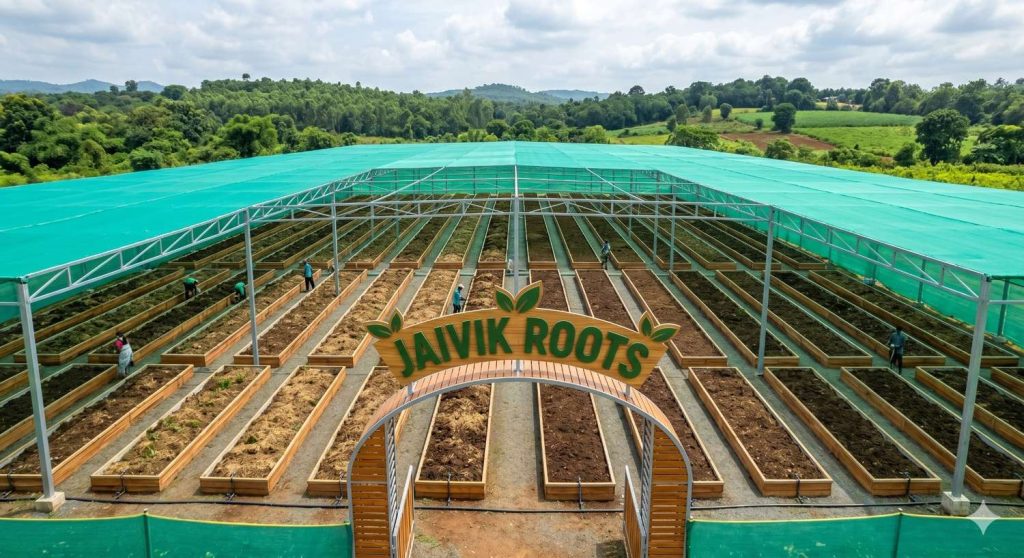
Vermicompost Unit Images from Our Raisen Farm
Seeing is believing. our dedicated Jaivik Roots production unit We use a mix of highly efficient designs covered by shade nets to ensure our Eisenia fetida worms remain healthy and multiply rapidly.
Start Your Business: Join Our Practical Training Program
Reading about unit design on the internet is a good start, but running a profitable business requires hands-on experience. If you want to avoid costly beginner mistakes, come visit us!
Join our 4-Day Residential Vermicomposting Masterclass at our Raisen farm. For just ₹15,000 (which includes your stay and organic meals), you will get practical training on live commercial units, exact structural blueprints, and learn how to calculate your profits and sell your compost in the open market.
Want to know your exact setup costs right now? Click the chat button in the corner to talk to “Ira,” our AI Agronomist. Just tell Ira your land size, and she will instantly calculate your required gobar, worm count, and estimated setup cost!
